


et cetera
-
Posts
115 -
Joined
-
Last visited
Content Type
Profiles
Forums
Gallery
Events
Posts posted by et cetera
-
-
Link to a thread by Dave Yabarra (West Coast Dave) and his collection of PBs, including one that looks very much like the OP. They can vary just like any marble type. Thank you for considering. https://www.allaboutmarbles.com/viewtopic.php?t=50813
-
 2
2
-
-
Looks like a Paul Bunyan ( packaged by Ravenswood but the production is attributed to Master).
-
1
-
-
Earlier Vacor Mummy.
-
2
-
-
Vacor Toxic Avenger - predates the Galaxy types.
-
1
-
 1
1
-
-
I agree with Alley here, and it looks like an early one from the Sistersville era IMHO. (Jabo for the smaller marble)
-
Well since nobody has given an opinion on this one I will offer mine. Not a CAC, and I have been collecting and studying them for years - just to give a little cred with my opinion. I do think it's a Peltier - glass looks it. It's hard to give it the 'Windshield' moniker due to the bizarre pattern, but the size and colors are right. I've seen some splashy / twisty examples and other variables of those, but none quite as wacky as this. Just my 2 cents!
-
Skipping over the dug Heaton in the 1st photo, and moving on to the 2nd and 3rd photos. Interesting on that Pelt in the 2nd photo (which might be an Acme Realer and not a PPP) how the splotchy dark crud is only showing on the orange patch and not the whole marble. I would think that indicates something awry in the molten orange only- some contaminant in the glass itself, and not something picked up on the rollers or the base glass would show this too. The 3rd marble has a lot of surface damage of which appears simply imbedded with grime or dirt, possibly from being buried. This is just what I personally see from the photos. Is it possible to pick up roller crud on only one specific colored part of a marble? That wouldn't make sense but I'm always open to explanations!
-
1
-
-
Oddball type Peltier Ketchup and Mustard - glass quality and colors plus blowhole looks very Pelty. No oxblood that I can see. Nice Marble!
-
They are all German Handmades but they are not all the same type. I would not call them variations of the same marble, although they are made with the same cane cut method.
-
 1
1
-
-
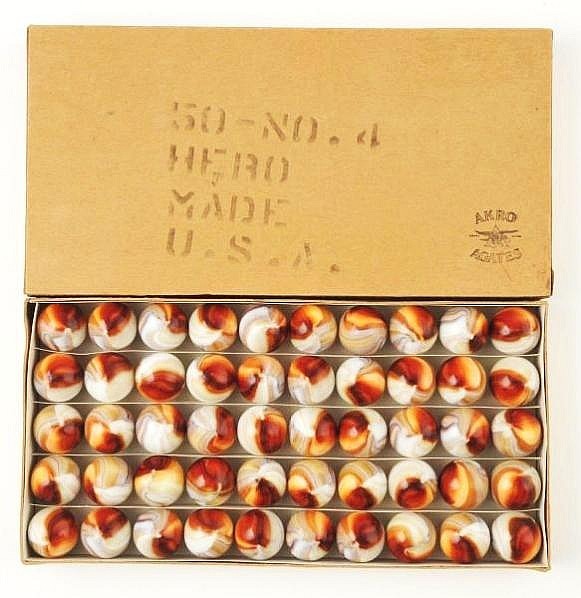
Thank you for that information Steph. This has certainly been a confusing subject. So many old discussions and opinions by those regarded as experts, makes me wonder what the truth really is. The whole Master acquisition and all deepens the mud. Makes me wonder if either late era Akro or even Master made similar marbles to those types, then Master added other color combinations and just revived the name UNIQUES. Here is one photo I saved in an Akro company box. I have seen examples and photos of purportedly early Akro Heros/ Grebes/Brown Thrashers/Uniques (or whatever you want to call them) and they do exhibit what appear to be early traits - so I will still keep wondering I guess. Thank you for your time and understanding my query.
-
The explanation perhaps is the fact that in 1951 Master Glass acquired all of the remaining Akro assets. This included Akro's remaining marble stock and left over packaging. Master sold this stock in old Akro boxes as well as their own Master labeled packaging. This would explain, at least to me, why later era multi-colored Akro patches can be found in mislabeled packaging.
-
1
-
1
-
-
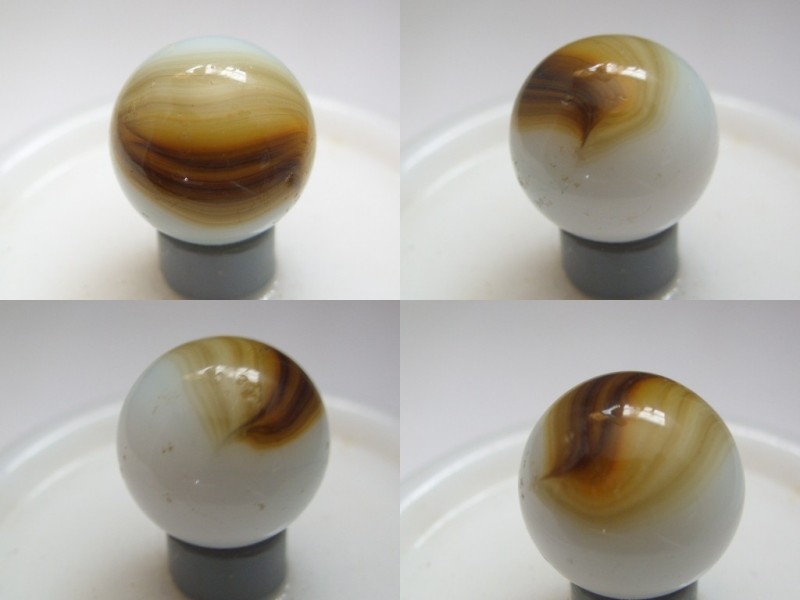
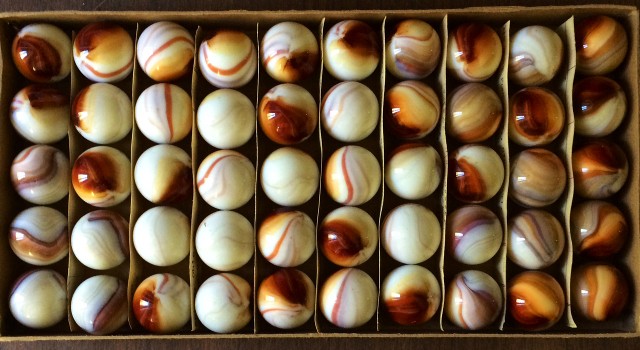
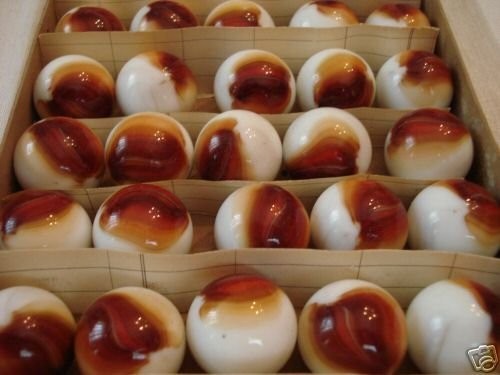
I thought the Akro Heros , Brown Thrashers, Uniques and Golden Tawneys are all early Akro patches - and all are white based (or close to white) with varying types of brownish patches. Here is a large box of Hero/Uniques from Bob Block, a smaller box of all Heros and single marble Hero Brown Thrasher. I am still searching for a shot of a Golden Tawney. I don't understand what all those colorful patches are in boxes labled 'Uniques' - like Akro just back filled left over Unique Boxes with ...whatever colored patches ?? Maybe someone with deep Akro history knowledge can elaborate here.
-
1
-
1
-
-
Winner! This is an old St. Mary's era MK Watermelon. Very nice find.
-
1
-
-
The Vacor Atmosphere is one type I find impossible to authenticate when outside the original packaging. Most of them are so random how do you differentiate between genuine and the abundant knockoffs- or just simply someone 'experiment'?
-
1
-
-
So this is a green base with orange ribbons (not red) - which means it is an Orange Dragon? If so those are pretty HTF. Or maybe you mean red w/orange ribbons when you say "orange flame" which is a Flaming Dragon?
-
Base glass look blue in some views and green in others - so Dragon or Spiderman?
-
1
-
-
I'm not sure if all authentic German HM Melon Balls should have a ground/faceted pontil, but those I have seen in hand did. Sometimes these faceted pontils are so finely executed they are hard to see. Look with a jewelers loupe.
-
1
-
-
A birthday cake I made where I accidentally used 1.5 cups of salt instead of sugar. Not my kitchen. Please label your plastic dry goods containers when transferring bulk products for storage. Cake looked gorgeous but.... what a shock. GOT MILK? LOL
-
 1
1
-
-
Has a Ravenswood look to me w/ those colors and pattern - but not positive.
-
Glass sure looks Vacor - especially that hazy bleeding white. Lots of Roosters and Firefighters have that same spotty edge bleed.
-
I would glue it on with some LOCTITE Glass Glue if you're keeping it and not trying to sell it. It will look better repaired.
-
1
-
1
-
-
Chuck G - I have heard/read the same discussions on the possibility of lower production numbers for the Akro white/yellow cork. Of course if this was actually the case it would further reinforce the proportionate scarcity of this color combination. I never knew if this was collector speculation or if company records existed with run numbers by color. Either way I always look for these simple yellows in minty condition and consider them keepers.
-
In my own experience a pristine mint yellow on opaque white standard Prize Name has been hardest to come by. The theory is that yellow was the most unpopular color, especially among boys. I think many of them saw heavy play action since the yellows were not considered a big sacrifice or loss. Kids tended to save their more favorite colors like blue and red. I have tons of mint corks in vast arrays of colors but only 2 mint yellows.
-
1
-
2
-
-
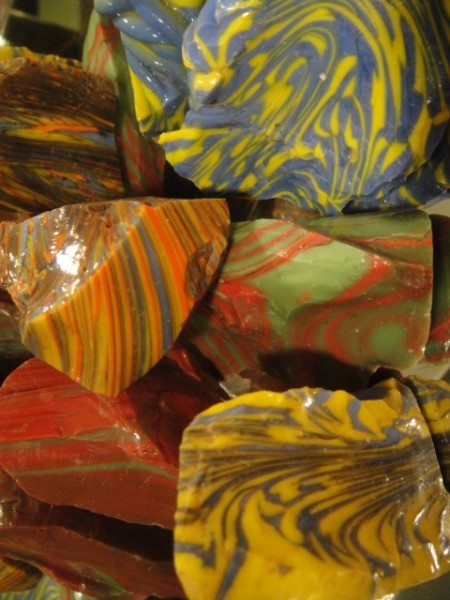
I agree the cullet may be Akro - below I show some dug on factory site Akro cullet. As far as the whole marble goes I would have reservations about that being CAC as well. Looks 'off' - particularly with all those dark bleeding striations running right through the yellow. Looks more like an Alley West Virginian in that single shot.
-
1
-


Kokomo shooter?
in Marble I.D.'s
Posted
Have it your way! I'm just saying Paul Bunyans can vary not just in color (or lack thereof - solid green examples exist for example) but also in size up to 15/16th and 1". You can find a lot of research that confirms this by reputable collectors . If you don't think the link marble variation is a match- that's fine. I'll be interested to see what the end consensus is here. I don't have any other guess.