

Steph
-
Posts
29380 -
Joined
-
Days Won
40
Content Type
Profiles
Forums
Gallery
Events
Posts posted by Steph
-
-
Oooh ... it starts to get interesting .... I think this might be getting closer to what you want ......
Go down to #17 and start reading from there:17. The Freese patents, Nos. 1,529,948 and 1,529,947, deal respectively with an apparatus and method of mixing clear and colored glass. They are substantially identical in drawings and specification with one another; the claims in the apparatus patent No. 1,529,948 differ from the claims of the method patent No. 1,529,947. *323
The next sections talk about Freese methods and how Master's method differs from Freese methods, and what part of the technology was known before Freese.
After reading those sections, it makes it very hard to understand how Master got such nice results in their tiger-eye style Sunbursts. -
It's morning so I'm making an attempt to read again. (Was not easy last night! lol)
Method of delivering glass to rollers is mentioned, but in a way which makes it seem inconsequential:
10. That plaintiff failed on the trial to show that defendants' rolls contained the combination of features set forth in claims 2, 3, 4, 5, and 6 of the Early 1932 patent, No. 1,880,916, while defendants proved on the trial, and demonstrated to the court when he visited defendants' factory, that instead of defendants' machines embodying the combination or group of devices stated in said claims of the 1932 patent, defendants' machines, as to the devices for delivering the glass gobs to the roll grooves, were of the type and construction open to the public, because old and shown in numerous patents of prior dates: Among them, Miller patent, No. 1,601,699 of 1926; Lynch patent, No. 1,531,560 of 1925; and Bingham, No. 1,125,895 of 1915; and the Miller prior use heretofore referred to. (Exhibit KK, Book Prior Patents.) -
I could be wrong. I didn't read every detail. Sounds like it the lawsuit was about the rollers, not the injection method. Definitely rollers were involved. If injectors came in, I didn't see where.
Part of the "Findings of Fact":
4. That the defendants' machine was independently arrived at by their own experimentation and construction; that the defendants at one time experimented with offsetting of rolls on their machine and found that the product was imperfect, and at a later time found that misadjustments of the machine by offsetting resulted in an imperfect product (Rec. 650, 651); and I find that the defendants spent some $9,000 in independent expenditure in experimenting and producing their own type of machine which is the subject of this suit. (Rec. 506, 507.) -
-
-
*bat signal to the patent researchers*
-
-
I had to go to the post office last night.
I should say yesterday afternoon.
But it was dark.
And it was 4.
-
Wow ... thanks for the monitor background!
-
-

That poor little pup was in great distress, so laughing doesn't exactly seem appropriate .... but ................. so funny. And I'm sure he feels loved enough with his main man to make up for it all.
-
That layer of different shades floating on top of the main transparent ribbon is what made me think of Alley -- Pennsboro Alley, in fact.
I don't know if other makers had that kind of layered transparency. But Alley sure did.
-
I suppose that was a strange use of the word "early" for a company which existed since the teens.
Akro seemed to have a revolutionary switch from its slag days to its cork days, right at 1929-1930, and so I meant that Sparklers came early in that switch.
-
I think it was early. Early enough for Master's founders to take some of the know-how with them in 1930.
Their first appearance in Akro ads of which I am aware was in 1931.
They are not in the 1929 ad I know about.
I can't remember seeing a 1930 ad, well, not a full Akro ad which listed the company line. (A 1930 advertisement from a distributor does mention Akro Tri-Color Agates ... the marbles known to some as Specials ... and I don't see Sparklers there but that doesn't mean anything.)
I still see Sparklers in an ad which I think which was printed in 1934 or later.
(I'm consulting American Machine-Made Marbles and this thread, http://marbleconnection.com/topic/10676-akro-timeline/, to refresh my memory.)
-
I don't see Jabo either.
Messed up cork?
-
-
My first guess would have been Alley.
-
-
What is the technical difference between a slag and a swirl, other than the generally earlier time period in which most slags were made?
-
-
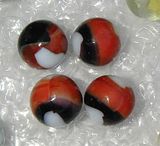
Here's my mutant 7-up. That red coverage had me going so long I didn't even know it was a Pelt.
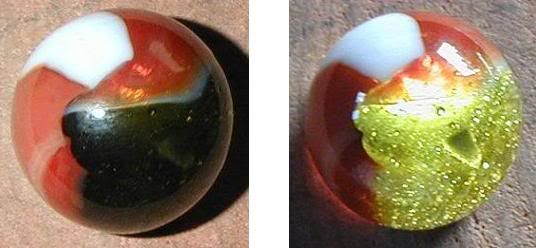
I didn't even know the "black" was the base or that it was transparent until one day the sun hit it just right. For the longest time I had it stuck in with my Rainbow Reds.
-
Sticking with Sunset.
-
7 ribbons?
-
Plain Jane NLR's do exist.
And yes, I agree, pattern says NLR on that one.
There are six-ribbon Rainbos.
However, I am inclined to think NLR-era for yours.
Akro Sparkler Production Dates
in General Marble & Glass Chat
Posted
Down near the bottom, in the Conclusions of Law section, this was interesting:
Reading between the lines it sounds like it's possible that Master was doing some of the same things Akro was doing which Akro considered special ... But we can't be sure since the lawsuit wasn't about that. It was only about whether Master was involved in patent infringement.