

Steph
-
Posts
29378 -
Joined
-
Days Won
40
Content Type
Profiles
Forums
Gallery
Events
Posts posted by Steph
-
-
I'll go with annealing fractures.
My guess would be that it was a temperature issue. Or maybe temperature combined with getting knocked around. I wouldn't guess mismatched COE's because surely the company would have gotten those basically right before they did the run.
-
 2
2
-
-
If American then, Master.
I wouldn't call it a cat's eye or even try to figure out a style name for it. I would just say "Master".
However, it might not be American.-
1
-
-
Mojo, I think Vacor on that two color one of yours. (And also on the first three.)
Japanese on your white cross-through.
I'd guess four of one color and two of another should count as uncommon to say the least but I can't really weigh in on that for Vacor.Vacor can do some really wild things. Having three nice clean pairs of vanes might actually be less common for Vacor.
-
2
-
-
Yep.
There's a thing to note about the word "hybrid".In most marbles, it would be thought of as something unintentional. An Akro popeye, for example is supposed to have two colors plus white in a clear base. If there's an extra color it's thought to be accidental, probably happening when one color was running out and another color was being added.
With Vitro, these multi-color cat's eyes were done on purpose. But still we call them hybrids.-
 1
1
-
-
The cross-throughs are all considered collectable.
Yours is "just" a white cross-through, which is not too terribly hard to find in the normal 5/8" range. But at that size? Most definitely a keeper.
-
1
-
-

-
1
-
2
-
-
Does that white cross through? That would be fabulous at that size.
Could be vintage Japanese ... or modern Mexican ... I'm leaning in the Japanese direction at the moment.
-
1
-
-
I think we used to call those European sparklers without anyone worrying much about it.
Yours are glorious. That top one is oolala.
-
2
-
-
I don't know of a nickname for the Pelt Rainbo.
On the left I sort of want to say Alley but I don't know if the Alley I'm thinking of would be translucent. -
I was more than a little hopeful that Halloween would be occur between Monday and Thursday this year. So I would be working at the evening job that I started last November. But since it's on a Sunday, we'll probably have stuff for the trick-or-treaters.
Wait! Since it's on a Sunday, my husband won't have an excuse not to do it! He keeps buying candy and toys and putting them in goodie bags with the assumption that I'll hand them out. He can do it this year! Muwahahaha.

-
 4
4
-
-
-
3 hours ago, Chad G. said:
You being from the UK & seeing your other posts I would gander to say these are foreign to the US as well ?? "To me" they almost look like some kind of Wire Pull ??

In this pic it looks to loop around and around w/o separation, like a pull does, the strands also have that 2 tone (or color) look ?? Someone will come along and know exactly what they are, Josh (NANTUCKETDINK) or "Alan" will probably have a good idea !!
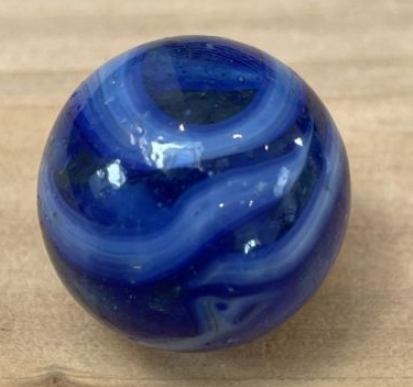
I didn't notice that he was from the UK. Some of the white had a bit of a foreign look to me, but I let it go because it was more wispy that I would have expected with the white I was thinking of.
But if these were found in the UK, then I should have kept non-American on the table.Of course, West Virginia companies did export their marbles, so that's still possible, I suppose.
-
"transparent swirls" might be the best that can be done.
If vintage, then odds are they were made in West Virginia. -
2 hours ago, akroorka said:
Thanks Steph,
I was writing this while you posted so I will post it as well.(I worked on it a while and do not want to waste my efforts)
It is a hard thing to explain the difference between a machine made marble and a hand gathered marble to someone that is new to this hobby. It takes some research to determine what the difference is.
There have been many “Imperial Jade” marbles for sale on E-bay for a quite a while. The name is quite catchy and it attracts interest. Most are misrepresented.
The folds and seams in your marble do not point towards anything “hand-gathered” and the experience of the collectors on this board will agree that is a machine made marble.
Hand-gathered marbles are what MFC produced. They more often than not exhibit a swirl effect that starts with a version of a “9“ that will swirl around the marble. The swirl effect often encircles the entire marble, often many times right down to the cutoff mark and over the top of it which is usually quite well encased into the glass itself. The more swirls or fine/thinness of the tail that the marble has—generally the more desirable, they can come right down to a very fine point.
This is not always the case of course but if these attributes are not shown in a hand-gathered marble , the marble itself will more than likely not attract the attention that it may deserve and end up with the enormous (millions) amount of “solids “or “slags” that are out there in the world.
When these marbles were “gathered” out of a “pot” of liquid/melted glass onto a rod, they were twisted to get a ball of glass on the end before cutting and dropping onto a simple mechanism to make the glob of glass round.
This is about the best that I can do to answer your question. Some examples of hand-gathered marbles will help you to see what I am trying to explain. Do some research on them and find the light.
Marble—On!!!
Art, I was trying to think of how to describe the kind of swirl that one might see "encircling the marble" from the glass being twisted around in one direction during the handgathering process, compared to the more wadded up swirl from the machine-made process. I gave up on it, but I think you made a worthy effort!
-
1
-
-
MFC's are handgathered marbles.
They were made by someone sticking a metal rod into a pot of molten glass, then pulling out a blob of glass, spinning the rod in one direction to get the blob into better shape I guess, and then cutting the marble off the end of the rod. Then the still-molten marble would go down rollers which would help it become more spherical before it cooled off too much. This process creates a recognizable pattern in the glass, typically with a cutline on one end and a "nine-and-tail" on the other end.
Your green marbles are machine-made. The first does appear to have a swirl pattern as you mentioned in your original post. The second appears to have a seam, meaning it likely would have come from a company which made patches. That could help narrow down the maker. The maker won't be MFC though.-
2
-
-
1 hour ago, Newblue said:
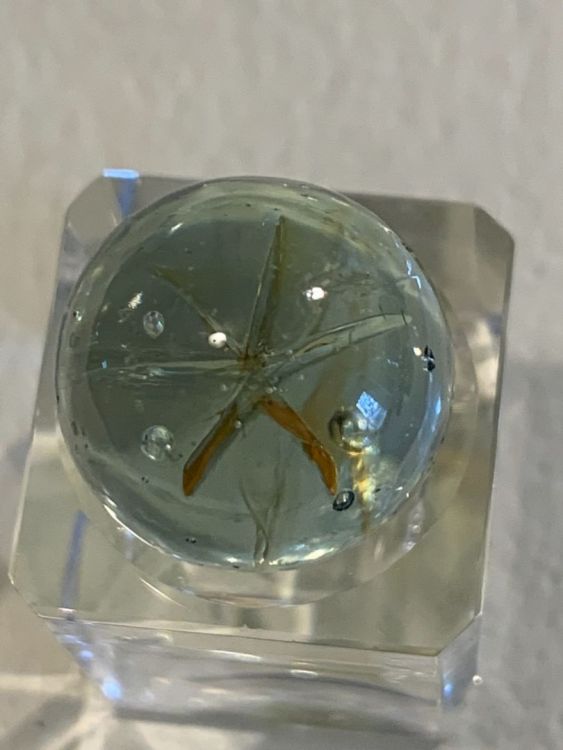
Thank you so much. With my untrained eye, it looks like all three veins, orange, yellow, and white, all cross through. Am I misunderstanding something?
In the top photo it looked like two yellows next to each other on the top side and two oranges next to each other on the bottom side (with only the white having vanes on opposite sides).
-
Older Asian. I don't know if old enough to be considered "vintage" (which is pre-1970), but still oldish. I wanted to say Japanese, but I can't swear on that either.
With the white vanes being on opposite sides of the marble that's called a "cross-through" cat's eye or "cross-thru" or "x-thru" ... you get the picture.
Cross-through cat's eyes are among the more desirable ones. If you can get a non-white cross-through pair or if all three pairs cross through, that's even better.
Robust solid color vanes are good for displayability. Translucent vanes could appeal for being less common.
-
Even with swirls and differences in shade, these are generally considered solid-colored marbles.
If small they would be called "game marbles."
At nearly an inch, you might have a better chance of nailing down a maker than in the small sizes. But in general, it's really hard to get an ID for a solid-colored marble.
-
-
As Popeye the Sailor would say, faskinating.
-
1
-
1
-
-
My thoughts were that distinguishing the ones which actually do look nice and look somewhat like Vitros from the really cheap definitely modern Asian ones with the cold-roll v-cutline could be useful. These pretty ones with longer seams are worth another look. And that extra look could be a step toward finding out who made this style.
Names generate interest. And supposedly we're interested in learning more about the marbles which show up more in Europe than in other places. Our understanding of European marbles has a lot of gaps.
I see Mojo as ideally positioned to help on the project of filling in those gaps. And I see these pretty non-American non-Mexican marbles as a worthy style to consider along the way of filling in the gaps.And the name "Sherbet" avoids confusion with the names used for American marbles.
So I see more pros than cons here.-
1
-
-
At minute 17?
Maybe the version of Heaton that I might previously have thought was Ravenswood. -
-
We are split into a new thread now.

I've linked to the old one, for your reading enjoyment.

Help needed to ID
in Marble I.D.'s
Posted
We have a winner!