

Steph
-
Posts
29380 -
Joined
-
Days Won
40
Content Type
Profiles
Forums
Gallery
Events
Posts posted by Steph
-
-
Go out into the sun and rock the marble back and forth a little and see if you see sparkle. (Or a bright light inside would do.)
Sometimes the copper using to make green will ... aw heck, I don't know the process ... but sometimes it will sparkle.
-
What size are we looking at?
The three in the 2nd picture look new to me. (After 1990.)
In the original picture, the top middle and the bottom right look intriguing in that single view.
The top right looks modern to me also, in the single view. Other views could maybe change my mind. -
Hiya.
 they came out easily ... I did toss some dry blossoms alongside a fence to see if any start on their own next year. I'll start a number of these inside. For fun. And to get plants earlier next year than I had this year.
-
Hi. Welcome. That's a coincidence.
Nice one though! Some people build alphabet sets just for fun. Such a definite capital R would not be easy to find. It's a keeper.
My first guess for maker is Alley Agate, from the 1940's. -
Thanks, Ron.
keeperthread
-
By george, I think he's got it!
So that was the case for many of the swirl companies. And that gave the "lower quality" glass we often see in the swirls.The slag companies made their own glass from the raw materials, and that's why we sometimes think of the slags as being nicer and more solid than the swirls.
-
A piece of Heaton cullet. I think the white came from Vitrolite. (Posted in another thread today, so I figured I'd add it here.)

Blacklight! ... this picture came out pretty well. Gotta remember which settings I used.


-
 1
1
-
-
17 minutes ago, Mikie_T said:
So I understand... This is a cullet that was going to be Vitro marbles but since they failed, they were in route to be sold to Heaton so THEY could be used in their marble making.
Now, the glass in this cullet could not be separated into blue glass and white glass....... So........ Heaton would just melt it and use it a recipe some way?
Mike
(This is interesting stuff!)
It's Vitrolite cullet. Not Vitro. Actually ... drumroll please ... the Vitro marble name came from the Vitrolite glass company name.
The founder of Vitro used to work at Vitrolite. And his initial plan when founding the new company was to use Vitrolite cullet to make Vitros.
As far as I know only the white glass in my Heaton clump came from Vitrolite. The blue glass game from a different source. And then those two colors were joined together at Heaton. -
Bonus ... way off topic ... Vitrolite cullet is known for fluorescing sometimes. So here's a blacklight shot of my Heaton cullet.
-
Here's some of the Heaton cullet I was thinking of. Four swirl marbles globbed together.
The white glass came from Vitrolite cullet (as far as I know). And then these four marbles didn't quite make it, so they became Heaton cullet. -
Slag glass was made by the manufacturer.
Some or all of the swirl glass could have been bought from other sources. Pretty sure they'd mix up the transparent separately -- maybe with their own mix or maybe from other sources, and then they could add the crushed cold cream bottles into that.
Cullet could be used on both ends at a marble factory. They could use it to make marbles. And they could create their own cullet in the process.
Vitrolite was a company which made glass products, and their cullet went to places like the Heaton swirl company. So Heaton could put Vitrolite cullet into their furnace and makes some swirls and then could have spilled some of the their molten glass or let marbles get stuck together in clumps, and that's how you get Heaton cullet.If you see Akro cullet, that's rejected glass at the end of the Akro marble making process.
-
What maybe unusual condiment selections do you enjoy? ... this question is brought to you by the soy sauce on my tuna noodle casserole.
-
2 hours ago, Mikie_T said:
This is a bit scary if you have doubts Steph.
The post above sounds like one of the best definitive explanations I am reading.....
QuoteVery clear transparant base and a nice hard white glass for slags. Less clear and softer white for swirls.
Yes, Galen (lstmmrbls) is a slag guy who also has lots of swirls -- and knows how to get to the point.
And yes, this other one of yours is a good example of a slag. The structure helps us in a big way though -- that's a Christensen Agate structure. And some other companies have very distinctive structures on most of their slags.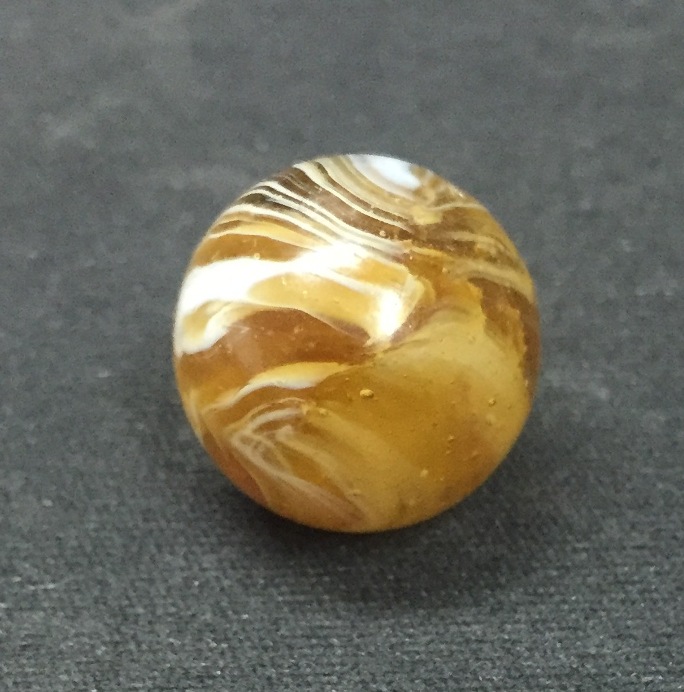
One problem comes with Akro, which had a more randomly swirly slag before they switched over to corkscrews and patches in 1930.
-
1 hour ago, Mikie_T said:
I guess I don't feel so bad about not understanding the difference. It even sounds to me like the ones who know even have a hard time with identification sometimes.
^^ that!
What you're seeing is how hard it is for us to describe it. Just gotta encounter them many times ... and even then there will be some on the border where you can't swear whether they're from an early slag company or a later swirl company.
The white in the slags will usually be a purer, solider white. And I'll say usually ... it can get wispy on slags, and it can be solid in swirls.
One thing about slag glass versus swirl glass -- slag glass is (usually?) made from "batch" -- where they stirred up the glass with a special recipe.
And West Virginia swirl glass is (usually? often?) made from cullet. Rejected glass from some other place. Maybe from a factory which made art glass. Maybe from cold cream jars. For example.
Sooooo ... yes ... there are some which are slam dunks ... but there are some ... like your dark one ... which can be hard to tell. -
Here's some of what I had in my miscellaneous swirl box

-
-
Here are some miscellaneous slags. At least I have thought they were all slags. I stored them together. Now we've got me wondering though about a couple of them. Still trying to remember where I put my tin of miscellaneous swirls.

-
ha! you can play checkers with it. You turn it to the fancy side when someone says "king me".
-
Maybe instead of injecting we're thinking of whether there are separate pots of color.
Slags had the white and the color in the same container.
Unfortunately, I _think_ many swirls also had the colors mixed in the same container, and that I've never understood. I _think_ some had different containers for the separate colors.
Ooops, I still don't have pictures. I will not return without them! I hope.
-
Need more comparison pictures! I can probably get some today -- finally finished the project for the 11-year-old -- but I know other folks' pictures will be better!

-
candy!
-
I'm having trouble finding the words. Greatly hoping someone else comes in with more pix or more words.
-
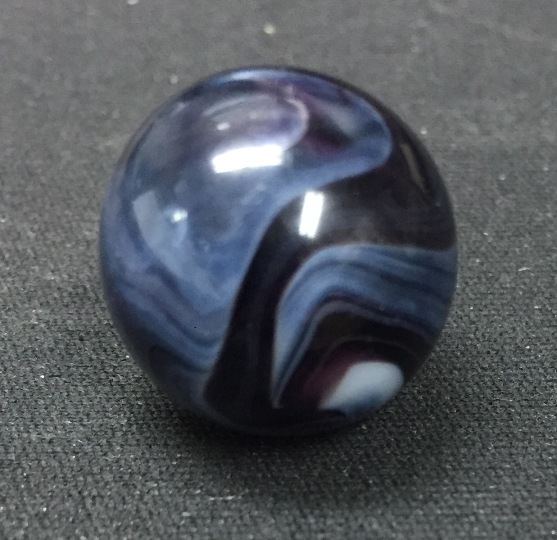
The base can be deep transparent purple on both the slags and swirls.
The brushing color makes me think of a slag but where the ribbon tightens up and seems to dip into the marble at the bottom of this shot makes me think of a swirl. (When there's a single ribbon darting around, definitely a swirl.)
-
A LOT more examples would help this thread.
Hint, hint.
Oxbloods... show me some please
in Archives
Posted
Gotta love some Akro ox.
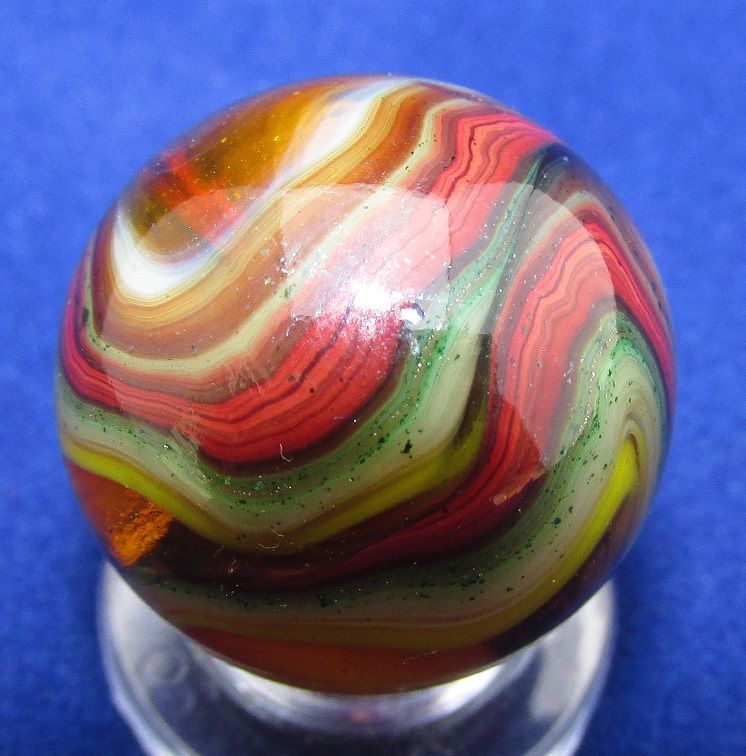
This picture turned out okay --- Jabo Last Dance