

Steph
-
Posts
29380 -
Joined
-
Days Won
40
Content Type
Profiles
Forums
Gallery
Events
Posts posted by Steph
-
-
Piece of trivia which _some_ reading this page might not know --- "Fire Opal" was the winning name in the Prize Name contest of 1930. Supposedly the winning name was what corkscrews were going to be called after that. But obviously that never happened.
-
What is that?!
A fancy pincher? European? -
I agree that it looks like a swirl like a WV swirl company would make, not Akro. An Akro with those colors would probably have a little bit more corkscrew action.
Does the base glass glow under blacklight?
-
Zaboo has an ad ... somewhere ... which shows Fire Opals. I'm not finding it right now in my saves.
-
Yeah, not sure between slag and transparent swirl.
With the diffuse white, slag is a possibility. However, if it's just sorta randomly distributed, that points to Akro rather than CAC (assuming slag).If transparent swirl, then that's a later marble.
Slags ending in early 30's, swirls starting in early 30's.
-
That'd be my guess.
Is it smallish? -
Akro Moss Agates can have yellow/tan bases or white bases. Akros are known for long seams and cap-shaped patches.

-
I'll try to remember to hunt mine up. Today I have to do something for an 11-year-old, and I'm not sure how long that will take. I'll put a big sign by my computer to hopefully do it tomorrow if no one else does.
We have this thread which had a lot more examples ... but then Photobucket killed most of the pictures.
http://marbleconnection.com/topic/6790-mostly-pix-heaton/I'll have to pull out my Heaton box and see if what I'm remembering is as close to yours as I'm thinking ....
-
I got lots of marble books when I was starting out and they led to a lot of mistaken ID's -- so they can be good intros but feedback and adjustments will still be needed. Which you can get by bouncing guesses off of us, of course.
American Machine-Made Marbles which has Johnson as one of the authors is a good book for history, and it does have many good marble images.
https://www.amazon.com/American-Machine-Made-Marbles-Schiffer-Collectors/dp/0764324640
When I was starting out I found Bob Block's price guide to be most useful, but even that had some errors in it which made for a _few_ awkward moments.https://www.amazon.com/Marbles-Identification-Price-Guide-Robert/dp/076433994X/
(Well, this is the edition I used: https://www.amazon.com/Marbles-Identification-Robert-S-Block/dp/0764315749/)
We're starting to see more books dedicated to just one maker, such as the new Peltier book.https://www.amazon.com/Peltier-Glass-Marbles-Johnson-Biffany/dp/0692777822/
I'll add a good word for the latest edition of Everett Grist's Big Book of Marbles -- the edition Lloyd Huffer helped with. This one added a lot of good marble photos, with many pages on various West Virginia swirl companies.
https://www.amazon.com/Everett-Grists-Big-Book-Marbles/dp/1574326929 -
-
I would call it a moss agate!

-
Yep ... all the little threads ... they'll come together
-
Looking at the seam in #1 to get CAC.
Looking at the overall swirliness and lack of other stand-out features in #2 to get Akro.
And #3 is just a whole different family. Looking at the seams and general alignment of color to get Vitro.
-
-
I'd guess CAC on #1. Akro on #2. And Vitro on #3.
-
With it being both sorta busy and yet the ribbons not being very distinct, I think good chance of Champion.
And the colors are right for Champ.
-
exactly .. .they need to have that extra white -- and yours look so close except maybe not quite there.
Gotta be close relatives.
-
Gosh, no. Can't say.
Good odds of it being Alley. It seems within the Alley range in structure, and Alley was the highest volume producer of that kind.
But I can't rule out Ravenswood ... and with the translucent white I can't rule out Heaton.
Kinda wondering if anyone else thinks it could be Heaton.
-
Are these wedding cakes ... or somewhere in the vicinity of that family?
-
Ah, good choice. See, that's what happens ... whenever I start my list, someone comes along and reminds me of a great group I left out.
-
Oh, they're gonna like those. Pretty marbles.
-
-
lol ... yes, you may
-
This one is handmade. In Asia. Yes, I'd call it a pontil. Yes, contemporary. I don't think we've ever put a company name on these.
Slag or swirl.... how can you tell?
in Archives
Posted
Swirls are post 1930, we meant to say.
Here is a photo Dani posted once with slags in the column on the left and transparent swirls in the column on the right.
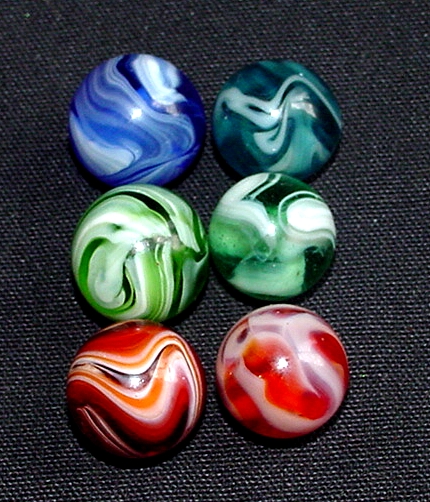
Usually we can tell by the ribbon shape in the transparent swirl. Sometimes if the ribbon is acting funky, it's the glass texture which will give it away ... hopefully. Sometimes it's still not easy to tell. The transparent swirl will _usually_ have a distinct white ribbon. I'm reaching for the right word to describe the white in a slag ... not finding it ... but it just seems to be more thoroughly connected with the base glass in the slag.