

Steph
-
Posts
29378 -
Joined
-
Days Won
40
Content Type
Profiles
Forums
Gallery
Events
Posts posted by Steph
-
-
Bo, my thought would be no. Both the structure and colors look different. I'm seeing a pretty distinct multicolor rainbo structure on Chuck's (3 distinct ribbons on each side). I don't get that multi-color rainbo feel from yours.
Plus, I'm guessing/assuming that a color arrangement close to Chuck's would be an important part of the salamander name. So not just any multi-color rainbo combo would do. The blue, white, red/orange and opaque green all being needed.
... is my assumption .......
-
-
I've seen boxes of Chinese checkers marbles with the Berry Pink brand on them. Don't recall having seen a board tho'.
Pretty cool.
-
-
You should give credit to the sources of the photos. You don't usually need permission.
I guess there are always exceptions. But sounds like you're talking about the sort of thing people do fairly casually without anyone getting upset.
-
Break Down on Postage and Handling Fees 3 Ounces in Weight $1.56 Delivery Confirmation .19 Mailer-Ink for Printer--Paper for Printer--Electricity--Heat/Air Conditioning--Pay-Roll--Cushion for Chair so my Lazy A$$ doesnt get tired typing all this drool ....

-
Or is there something else going on here?
One of the things going on is that the air isn't attached to the glass in the way glasses with different COE's would be attached to each other.
-
I do not rock.
I prefer a mellow ballad.
I didn't ask anything which wasn't in Chordus' original question.
-
The CoE of air?
I'd assume it was significantly different from glass.
However, I'd also assume that any pressures and strains from the air on the glass are negligible. That as the marble cooled the air would easily compress into whatever space was available without straining the glass around it.
-
Very strange. Seen any of these before? How does it reproduce? (lol, sorry, got caught up in the rare species motif)

-

the marbles
-
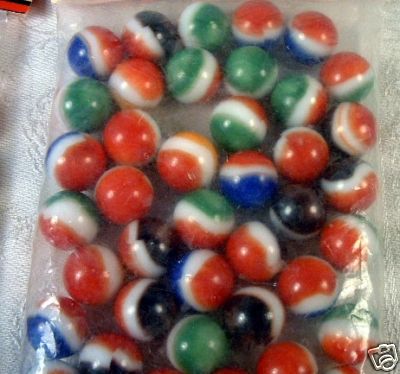
All-Reds
Had trouble finding a pic of some basic all-reds. So here they are. Next time I won't! Ebay auction pic.
-
Wow. That hit my jaw like a wedge of lemon. (that's a compliment. lol)
-
Here is an interesting biographical piece. It has errors. For example the birthdate is wrong, and one glaring omission is his affiliation with Rosenthal. But it's still kinda cool. The radio information is new to me. I'm inclined to believe that part's true.
My transcription from the book isn't perfect. I didn't have a good copy to look at. I might try to clean it up later.
Who's Who in American Jewry, Vol. 3
Julius Schwartz, Solomon Aaron Kaye, John Simons
Jewish Biographical Bureau, 1939
p. 815
Pink, Berry, mfr. Born Passaic, N.J., Aug. 18, 1900,s. Meyer and Anna (Horowitz) P, Ed. U. of Pa.: grad.Princeton Coll. 1919; attended U.S. Naval Acad.Enlisted in U.S. Navy as 2nd class seaman 1917:commd ensign 1917; discharged as sr grade lieut 1921;as head of War Risk Insurance Bureau, 3rd Naval Dist.responsible for conversion of millions of dollars worthof military insurance into present day forms ofinsurance, 1918-19. Asso.'d with John Aspegren, mfrof tank cars, N.Y. City, 1921-22, in U.S. IntelligenceDept 1922-33. Since 1934 engaged in manufacture ofglass marbles and reflectors; pres. Berry Pink, Inc., andUS Reflector Corp.; inventor of patented devicesemploying toy marbles as reflectors in animated andilluminated signs, road markers (in use in 30 statesin U.S.), R.R. signals, lithography, airway beacons,automobile reflectors, etc. Has studied the historyof marbles from their earliest appearance as playthings;has collection of 3800 marbles (some gold, silver, bronzeor amber and 1000 years old) which has been exhibitedin sch.'s and museums throughout U.S.; author book, Romanceof Marbles, 1937; broadcasts talks on marble playingand on clean sportsmanshiop and fair play over stationsWJZ and WABC and over nation-wide hookup. Mem.: Toy Mfg Assn,Y.M.H.A. Club: Army and Navy Officers. Synagogue:B'nai Jacob. Home: 74 Lincoln St, Passaic, N.J.Office: 101 W. 31st St, N.Y. City. -

thanks.
No, thank YOU!
-
Love the board!
Oh and the marbles aren't bad either. ;-)
-
Totally okay! Easier to see. No problemo!
(p.s., welcome
 )
) -
Thanks Chuck!

-
No. Too white.
P.s., if someone posted that for ID my guess might have been Akro on that one.
-
Alley on the Bull's Eye bag. According to the latest and most consistent information I've heard.
The Pressman/Alley connection was a strong one.
-
When Don posted this one I got the feeling that it might be unusual. I don't know though.
-
Thanks for the kudos! Been a rough day. And rougher for you than me. I liked that name game thread. Ran out of steam though. Am looking forward to the show and tell.

-
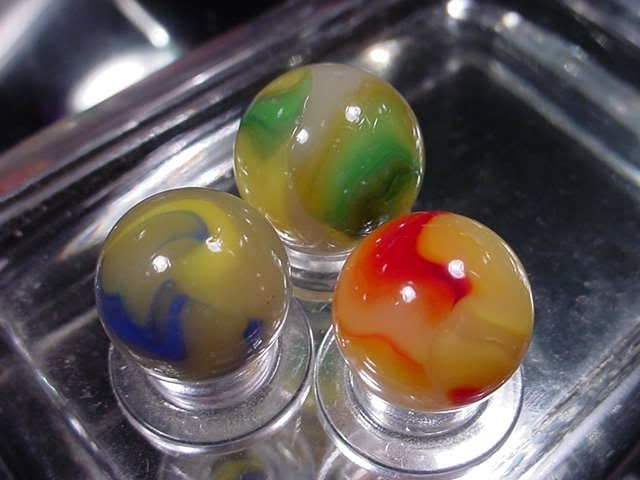
Blue Angel, Red Angel, Green Angel
Photo by Mibcapper:
-
Also, anyone answering Andreas question, could you please help us newbies out with a breif description of the characteristics? I see the photo (THANKS!) are those on vaseline glass (UV reactive?) What other features make an angel?
Here's a photo (Mibcapper's, I believe) which includes a green angel.
They have a tan custardy base. I think they are essentially a six-ribbon marble, but sometimes it's hard to tell because of how the ribbons smear and split each other. I'm pretty sure it's not a vaseline base, at least I'm pretty sure the one red one I sold didn't have one.
I think the blue angel was named first, by Smitty, after the Blue Angels flight squadron.
Julian Assange Marble
in General Marble & Glass Chat
Posted
Hi Chris. Do you post your work at any political forums? Serious question. Sensational work ......