

Steph
-
Posts
29378 -
Joined
-
Days Won
40
Content Type
Profiles
Forums
Gallery
Events
Posts posted by Steph
-
-
Have a great day. May all your birthday wishes come true.
-
The pink is perfection!
-
Actually, I HaVE seen a double ingot cat eye before. lol
Yours is certainly different (and I like it).
-
that's wild.

-
-
EDIT: Well, I glopped all this together back in 2010. It's now 2017. There was too much for me to sort through that day so I said to myself I'd come back to it. So it has been invisible and unedited all this time. I may never fix it, but it has cool links, so I'm making it visible. Maybe I'll clean it up 7 years from now.
Inlaying porcelain in glass appears to go back to the late 1700's. (Other items such as Ivory as far back as 1584.)
James Tassie is connected - and has a publication with the word "sulphur" in the title - which might be the inspiration for the name "sulphide". Not sure yet how closely connected Tassie's creations were to the little figures which we see in marbles. It's a catalog. If it describes the method I haven't seen that yet.
1775: A catalogue of impressions in sulphur of antique and modern gems from which pastes are made and sold
This describes how sulphur was used: History of Tassie
In 1818 in France and 1819 in England there were patents filed for Cameo Incrustation, aka Cameo Encrustation.
QuoteThe figure intended for encrustation must be made of materials which will require a higher degree of heat for their fusion than the Glass within which it is to be incrusted; these are china clay and a super-silicate of potash,* ground and mixed in such proportions as upon experiment harmonize with the density of the Glass; and this, when moulded into a bas-relief or bust, (in plaster of Paris moulds,) should be slightly baked, and then suffered gradually to cool; ........*By super-silicate of potash is meant, sand exposed at high temperature in a crucible, with a small portion of carbonate of potash, sufficient to fuse it partially, for grinding into an impalpable powder.The French patent was filed by Pierre-Honoré Boudon de Saint–Amans. The English patent was filed by Apsley Pellatt.
Early versions of the process were called cristallocéramie or variations such as "crystallo ceramie" or "crystallo ceramic".
The 1819 is given the most credit from what I see online, but this might be an error entrenched early and perpetuated over time. French patent predates the Enlish and one online source suggests that the English patent is a copy. That source says the name sulphide comes from bad cameo inlay work - a flaw giving rise to art. No date is given for the origin of the "sulphide" name though. Not that I can see. The author appears to translate the 1818 patent title to include the word "sulphides" but I don't see it there. Another sources says the name came from sulphur being used in making sulphides.
http://www.georgianindex.net/Shop/glass/p-gglassmakers.html
Is this the title of the Boudon patent?
Mémoire sur le perfectionnement de l'incrustation dans le cristal des camées
"Sulphide" is said to have entered the vernacular because the micro-thin layer of air between the ceramic figure and the glass gives the figure the appearance of a silver sulpide.
Very interesting: Art of Sulphides and Cameos
http://www.cristallerie-hartwig.com/history%20of%20sulphides.pdf
an html version of mostly the same material?: http://paperweights.cristallerie-hartwig.com/history.html
That might cast a completely different light on the material I originally posted, which is basically as below:
This page presents a history of sulphides in general, Sulphide Technique.
They mention an 1821 book written by Apsley Pellat on the subject. He took out a patent on "crystalo ceramie" in 1819. Also mentioned is an 1849 book he wrote, Curiosities of Glass Making. In that book there's a section on "cameo incrustation" beginning on p. 119.
The tile of the 1821 book is, Memoir on the origin, progress, and improvement of class manufactures: includ. an account of the patent crystallo ceramic, or, glass incrustations. It is 42 pages long. (source)
Some good date info for future reference - from the table of contents of a book, it appears.
QuotePellat - Apsley Pellatt on Glass MakingAPSLEY PELLATT Senior1807: Patent No. 3058: Lighting the interiors of ships, buildingsAPSLEY PELLATT Junior1819: Patent No. 4424: Ornamenting glass1821: Memoir on the origin, progress and improvement of glass manufacture1831: Patent No. 6091: An improved mode of forming glass vessels1838: Proc. Inst. Civil Engrs: Heating powers of coke and coal in melting glass1840: Proc. Inst. Civil Engrs: On the manufacture of flint glass1845: Patent No. 10,669: Improvements in the manufacture of glass1848: Curiosities of Glass Making()Another little bit on Pellatt, with some discussion of trends in sulphide making. Not sure what to make of it. Good chance this will get edited out. But it's here at least as a bookmark for now.
Apsley Pellatt Glass, from the Glass Encyclopedia
1968: Sulphides: The Art of Cameo Incrustation, by Paul Jokel
Baccarat of France is also known for them. Boudon might be forgotten.
-
Mine now!
You wrote it?!
-
That light blue color might be my favorite.
-
Bump again. Coming down the home stretch. Under an hour on some.
We're looking at a record high on one marble but still some affordable prices on some nice glass.
-
Have a great one Steve!
-
Bump!
We're heading into the last day. The last few minutes get very exciting. Prices can explode! Get your popcorn ready. ( :
-
Pinx? where are you?
She has some odd bananas. I might have some of her pix saved. I'll look. But it would be cool of course if she beat me to it.
One of the weirdest bananas I remember was white with a red dot in it, if I recall that correctly. Not sure whose that was.
-
that first pic is kinda cool. has a mineral look to it. too bad you couldn't do it on command and expect it to stay that way over time.
-
Happy Birthday Bill!

-
Did I forget to say that's neat?
. . . coz that's neat!
-
This was posted by Ron Tramontano and shared by Pete at Land of Marbles:
"Nadine MacDonald passed away last week after a long illness. She remained upbeat throughout her ordeal and continued to produce her handmade ceramic marbles when she was able to. Some of her work is available here at The Land Of Marbles. She was talented beyond words and will be missed by all who knew and loved her."
Best wishes and prayers for Nadine's family and many friends at this time.
-
There is a grading system here:
It's one which has M- at 9.0, NM+ at 8.9. . . It talks in some detail about how much damage is allowed at which level.
Not everyone follows that system. I've seen more than one person use numbers in middle to high 9 range for NM. They've actually said NM, and 9.5 or something like that. Making me wonder if it was a typo. But then I read all their auctions, and it has become clear that's how their system is. Gotta make mental adjustments, and look closely at the pix. :-)
-
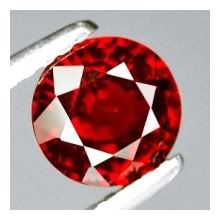
I did! Should I look up something specific? Found stones and a vase. Deep but still somewhat bright red. For example:
-
That's amazing, Roger.
-
you fixed the buttcracks?
-
Pop Quiz:
What color would you call the dark pink band here? I want it to be Chicken Blood!

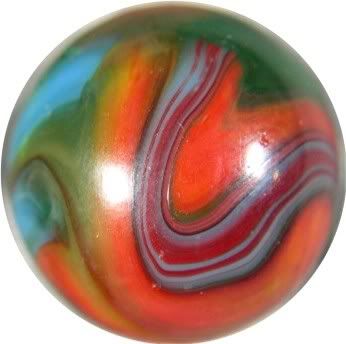
(I believe the marble is Carole's.)
-
Gorgeous! . . wooooooooooooooooowwwwwwwwwwwwwwww
A little google is a dangerous thing but what I just read was that the peachblow glass came after the peachblow ceramics. http://www.theglassmuseum.com/peachblow.htm
Found some pix of chicken blood (literally and in mineral form). Led me to think that chicken blood as a color might be somewhere around the darker pink shade on the pieces pictured here: Chicken-Blood Stone and A Jixue (chicken blood) stone seal.
And this is billed as a pigeon blood vase: Japanese Ginbari Cloisonne Vases akasuke or pigeon blood. And here are some stones: Pigeon Blood Red Rubies.
-
Here's a quotation with the names of some shades of copper-based glazes.
Those derived from copper give the more or less fanciful names of "sang-de-boeuf" "sang de poulet" "sang de pigeon," crimson, crushed strawberry, maroon, liver colour, and that curious tint known as peach bloom or peach blow.Anyone here just happen to have any examples of these other coppery colors lying around? The sang-de-boeuf is oxblood but what does chicken blood (sang de poulet) or pigeon blood look like, for example? lol
-
niiice one!


Stone Solitaire Help Please
in General Marble & Glass Chat
Posted
I've been wondering about either glaze or dye.
Dave, is the word you're searching for simply "facet" itself?