

Steph
-
Posts
29378 -
Joined
-
Days Won
40
Content Type
Profiles
Forums
Gallery
Events
Posts posted by Steph
-
-

I wouldn't have been able to tell on all of them individually, but the bright white on some of them in the foreign rows tipped me off. ( :
-
Is the red one oxblood?
I posted a link at Glass Addiction asking them to have a look: http://glasswizzards.yuku.com/topic/3594/Marble-ID-SOS
-
That's what I thought you said.
Still keeping my same guess. Guessing foreign on top row and 3rd row down. ( :
... so completely opposite of Rich's guess?
-
#1 (top) and #3?
(Which I'm only guessing because you said there were two.)
Edit: Silly me. I didn't say what I was guessing those rows were! I was guessing they were foreign!
-
Examples from Morphy:
Divided core: http://www.liveauctioneers.com/item/9133893
Single ribbon: http://www.liveauctioneers.com/item/9133892
Naked ribbon: http://www.liveauctioneers.com/item/1733073
-
Galen, did you mix up "naked core" and "coreless"? When I first saw the question I was thinking the same as you but now that ZZ has posted I'm like "oh right!"
In Collecting Antique Marbles, Baumann allows for ribbon marbles to have either one or two ribbons. (He says it's debatable with 2 ribbons would count as a double ribbon or a divided core.)
He also seems to apply the term "naked" only to the ribbon style marble - when there are no outer bands, like ZZ says. (So then would Baumann apply the word naked to a double ribbon?)
And then the divided core has more parts inside. Baumann says the production style of the divided core is similar to that of the ribbon core. But a divided core is still considered a different type from a ribbon core.
-
Oooolala. Them's some dandies!!! So . Much . Color .
No opalescence in the first cork when you backlight it?
-
I didn't even know you had my address!
That box full of marbles caught me by surprise!
-
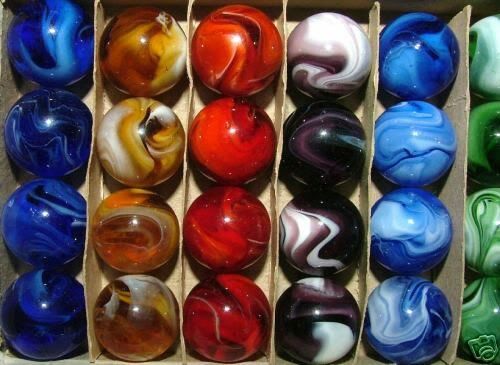
Here are some slags (circa 1920's):
-
right place at the right time - that's pretty glass.
-
yes to the oxide.
-
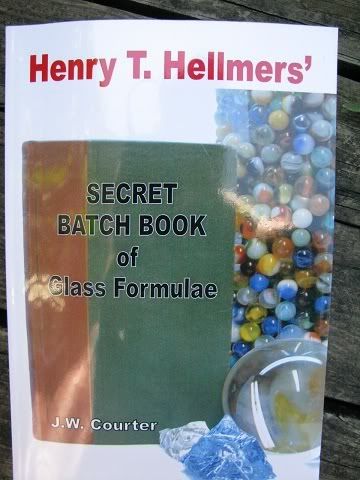
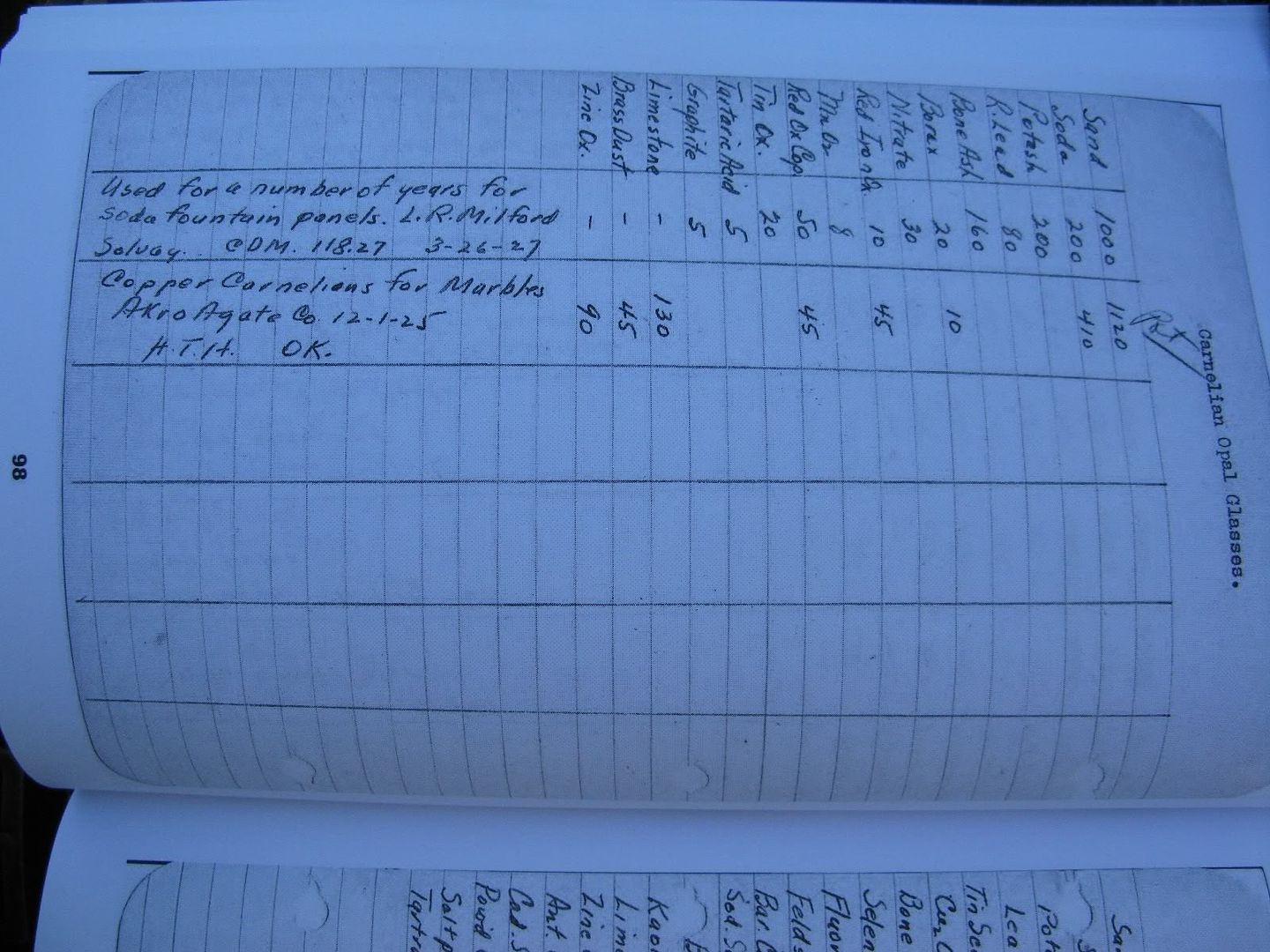
From Henry Hellmer's batch book. Has both iron and copper, and then more copper in the brass. And lotsa zinc.
From one of the "Carnelian Opal Glasses" pages:
Copper Carnelians for Marbles
Akro Agate Co. 12-1-25
H.T.H. OK.
Sand: 1120
Soda: 410
Borax: 10
Red Iron Ox.: 45
Red Ox Cop.: 45
Limestone: 130
Brass Dust: 45
Zinc Ox.: 90
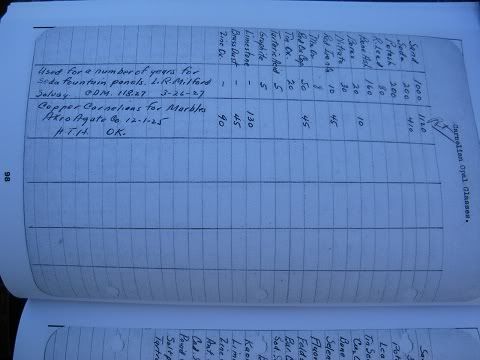
Formula page: http://i119.photobuc...odFormula_a.jpg (1600 x 1200)
-
I'm getting the feeling that they may have used the name "Carnelian" and "Cornelian" interchangeably in the early years. And maybe to them the name(s) would have applied interchangeably to both of the nontransparent red & white marble types available in the teens and 20's.
That would make sense in that time, I think, because carnelian and cornelian are names for the same kind of stone. IIUC.
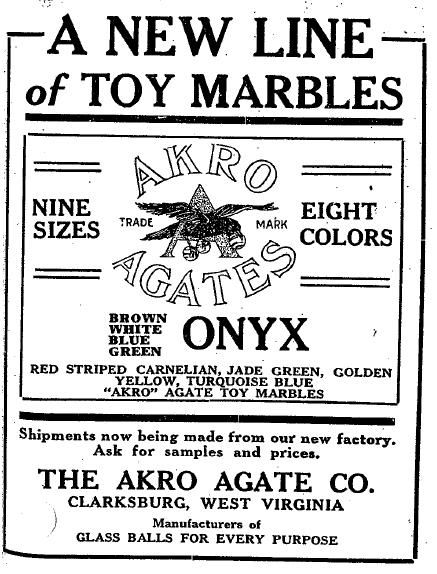
Their Dec. 1914 Clarksburg ad says Red Striped Carnelian: http://i119.photobucket.com/albums/o151/modularforms/Akro/1914_12_ClarksburgAkro_Playthings_b.jpg
And Hellmer's batch book gives a recipe for "Copper Carnelians for Marbles" for Akro Agate with a date of 12-1-25.
But of course boxes and other ads we know of from that era say Cornelians.
So maybe it was pretty much the same to them and they only made distinctions between the copper-based and non-copper-based types when it was time to mix up the recipe?
-
Interesting!!
-
Sometimes they do have something inside but that's not what the marble makers planned for us to pay attention to. The skin is about the ... skin.
Here's what you could see under an onion's skin but that's supposed to be hidden. lol.
http://marbleconnection.invisionzone.com/index.php?showtopic=7520
-
Yah. Not saying there are none with yellow tint but I have some pretty clear bases in my Master box and some came from original Master bags.
-
I don't know why you think the clear base rules out Master. This is the first I've heard about them having yellow base glass. That doesn't ring true with my memory.
*fishing out Master box*
-
That one you pulled out for closeups is pretty wild, Dave.
I like (love) that red one in the back with the white pinstripes. What would that be called? Is it a "caged" something?
-
Yeah, I guess I see one or two nice ones in there.

-
Yes, it was Don's. Here's where I saw it:
http://marblemental.....com/reply/8185
p.s., another neat Marble Mental thread about premiums: http://marblemental.yuku.com/topic/998
-
If I recall correctly, I have seen some with mixed makers. I remember being a little confused by them at the time ... trying to figure out if they really were mixed. I don't remember how many were in them. Could they have been Don's? Anyone recall those?
-
Not a plastic tube and only five "marbles" but while I'm in the neighborhood!
-
edit: 9 marbles? Hmmm, just six here.
-
Interesting observation, Bill.
They predate the roll out of the exotics by quite a bit. How much, I don't know. But seems a comfortable amount. That's why I voted "old" and why I was curious about the new votes.
Lobes
in General Marble & Glass Chat
Posted
One dictionary definition is that a lobe is "a rounded projection".
So I think that's what you're looking for with the lobes. 4 lobes being 4 bulges in the core.
I think "lobes" are different from "panels". I mention that because I think I've seen some people describing 4-panel onionskins as 4-lobed onionskins.