

Steph
-
Posts
29378 -
Joined
-
Days Won
40
Content Type
Profiles
Forums
Gallery
Events
Posts posted by Steph
-
-
Steph, Thanks for the pic. I'd not seen similar before. What do you believe about them now?
Still Pelt.

-
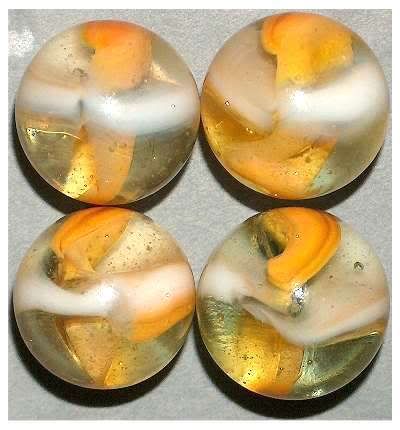
These were listed as Pelt and I believed it at the time.
-
Would you take some gratuitous cobra admiration?
-
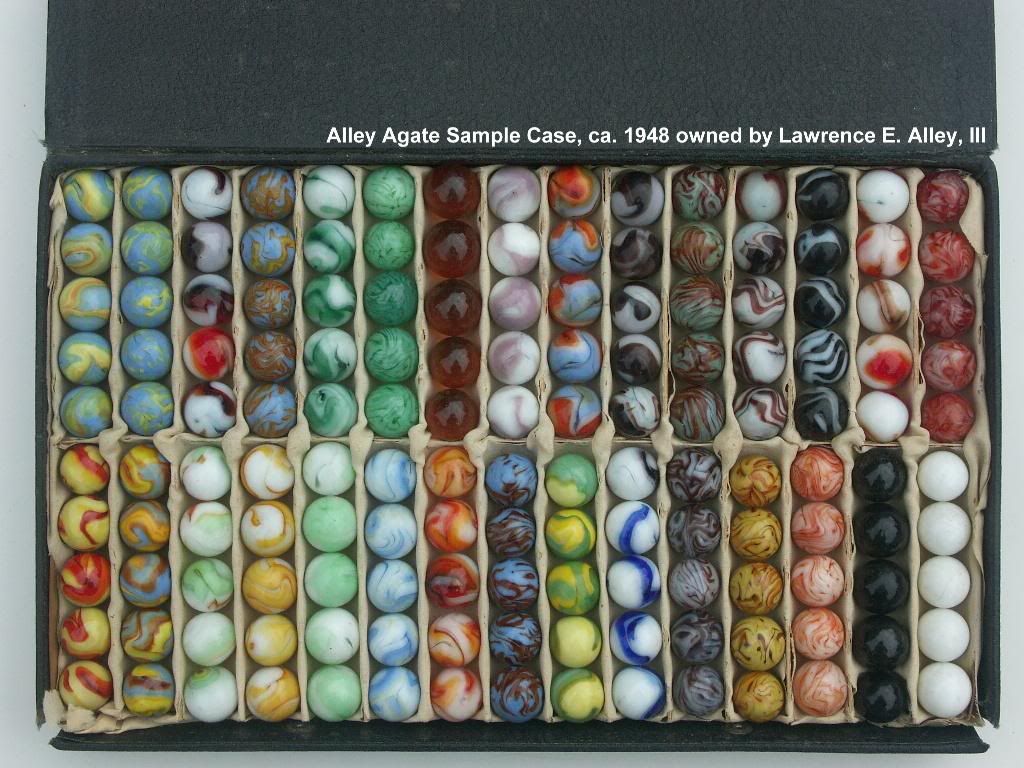
Came across another firmly ID-ed red, white and blue. Well, it was sitting in plain sight but I didn't make the connection. From the famous Alley sample case:

Seems a good time to renew the invitation for any other examples people are confident about. Thanks!
-
The more I read the more convinced I am that "ballast" came to mean something along the lines of "economy shipping" in addition to its original functional meaning.
If a manufacturer/distributor wasn't in a rush then they could get their materials on the ship as space came available. Ships charged money to take goods at a ballast rate. Seems like ships should PAY for ballast instead of CHARGE for ballast if it was just about functionality. But then somewhere along the way people figured out that they could save shipping charges by calling their goods "ballast", and then somewhere else along the way the people running the boats figured out that they didn't need to pay for "ballast". They could actually charge for taking it on board.
1914 book:
".... For the liner, if carrying such goods at all, is carrying them as ballast rather than as cargo, and accepts as a rule a low freight for the service."http://books.google.com/books?id=nn8pAAAAYAAJ&pg=PA191
That's just one example. Won't bog this down with links. I think I remember an 1800's reference to marbles being used as ballast. You may have seen it also and discounted it as an "urban myth" of the day. But the myths are starting to pile up ... seems to me. I can totally see barrels of marbles being treated as low value, low urgency freight and going the economy route.
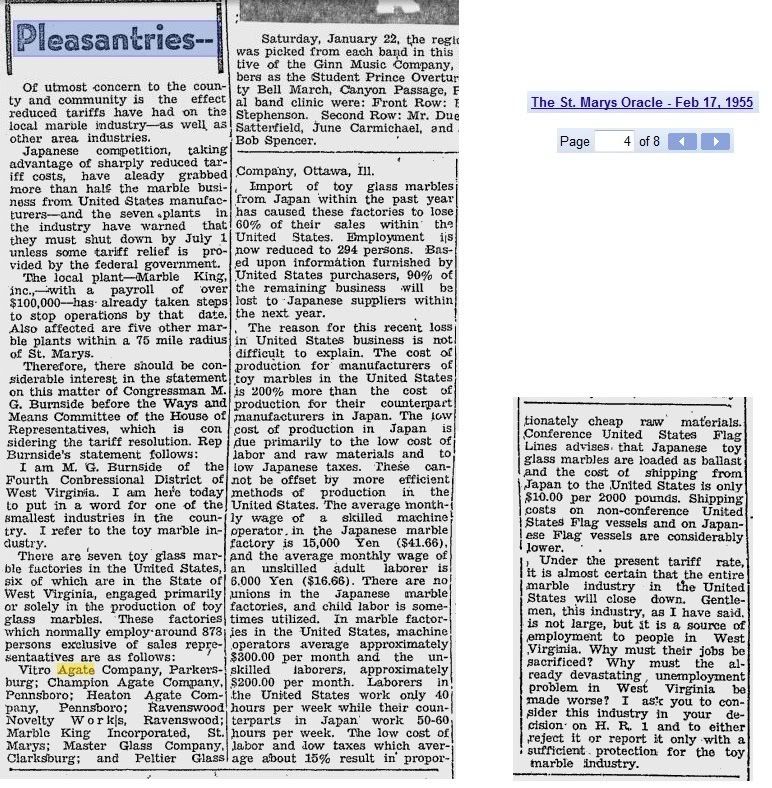
This next article is fairly specific about who is shipping what for how much in connection with marbles from Japan in 1955. Not quite as specific as I'd hope for further google searching. But rather specific nonetheless:
"Conference United States Flag Lines advises that Japanese toy glass marbles are loaded as ballast and the cost of shipping from Japan to the United States is only $10.00 per 2000 pounds. Shipping costs on non-conference United States Flag vessels and Japanese Flag vessels are considerably lower." -
I was sort of hoping that someone would start a thread about ballast. I welcome a chance to revisit the topic from time to time.
But this angle was definitely not what I expected.
-
I second that motion!
-
These are not glass and they were in my mother in laws old collection.
Not glass??
-
What does the red one look like on the opposite end? and what do the ends of the green one look like?
If it turns out that the green one doesn't look handmade after all, then don't let that one distract from the others! I just had a hunch that they might all be related to some other marbles I've been intrigued by.
-
To me that looks like a pontil on the red one.
I'm going to move this thread to the main forum because sometimes handmade collectors don't make it to the ID forum.
p.s., the colors and textures make me wonder if they could be from China.
-
I made a post here and it disappeared!
Should I try again or give up? lol
That's a fantastic whimsical piece. Any chance the marble is hollow?
-
I've seen three or four antique voting boxes in my life– the kind with the black and white marbles– and recently acquired one myself. From what I can tell, they were all made in the 1800s or very early 1900s. What confuses me is that the marbles I've seen in all of them are glass– I thought that glass marbles like this weren't mass-produced until Akro, in 1910.
Anyways, the question is: how were these marbles made? Or have all of the marbles I've seen been replacements?
Quick technical note: Akro wasn't producing marbles in 1910. When Akro started business they bought marbles from MFC. Their special gimmick was how they marketed the marbles. Akro put them in prepackaged sets of 5 with the Akro brand. This was a new thing. Akro started making marbles in 1914.
I've only had one ballot box. It had black and white bennington style marbles.
There were handmade ones in glass, with pontils, like mellonballs.
I have that ballot box book. Might be a good day to finally read it all the way through.
 p.s., it mentions lots of different kind of ballot balls. Even cubical ones. Materials included wood, rubber, composition, and more.
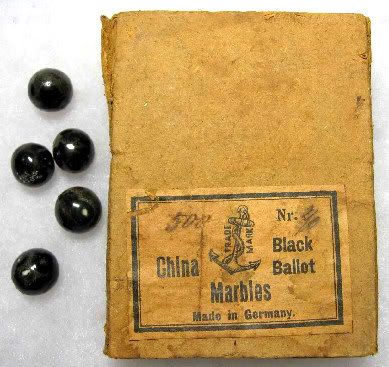
 Here's a pic of ceramic ballot marbles:
-
-
Is it your next birthday yet? Or is this one still going on?
Happy belated birthday.

-
Sorry to see you parting with them. Thanks for letting us know.
-
yah, he knows.
-
Marblealan auction ending July 21: http://cgi.ebay.com/350477743520
mrsmaniord auction beginning July 20: http://cgi.ebay.com/130550030530
-
Pink champagne glass is a winner.
-
Took me a bit to get past the image of the flame during this heatwave. After that I was on the edge of my seat.
What does the final product look like?
Ah, I think I've found it! http://glasswizzards.yuku.com/topic/3419/Rembrandt
-
I wondered how smooth the colors were on the surface. Then I remembered I have guinea fragments even though I don't have a guinea. The color is very smooth and very thin on the surface (interesting). But one of my fragments is about a third of a marble. It has a core of color in the middle, plus all the color around the outside. Seems that should tell me something. But if it's talking I'm not hearing very well.
-
-
Does anyone have any good close-ups of guineas to illustrate the discussion of how they might have been made?
Thanks.
-
Those are sharp!
(Thank you for sharing.)
-
I don't remember the all-red style name still being used in the 1980's. That is, I don't remember seeing it on a bag. I have no idea at all though what names the company used for the marbles in their internal documents. Thanks for the compliment, Edna. There are at least three people who post here occasionally who have a better grasp on Gladding-Vitro and Paris Mfg era packaging than I do. Sometimes I think wistfully about how much more I could piece together with a few hours in some folks' bag and box collections. *drool*


New Book
in General Marble & Glass Chat
Posted
In case anyone isn't up to speed on the timeline controversy, here is an interesting thread:
http://www.landofmarbles.com/phpbb/showthread.php?20233
p.s., the book does say that Fiedler worked at Peltier briefly starting in 1924, so the disagreement appears to be when he left Peltier to go to Christensen.