Steph
-
Posts
29334 -
Joined
-
Days Won
38
Content Type
Profiles
Forums
Gallery
Events
Everything posted by Steph
-
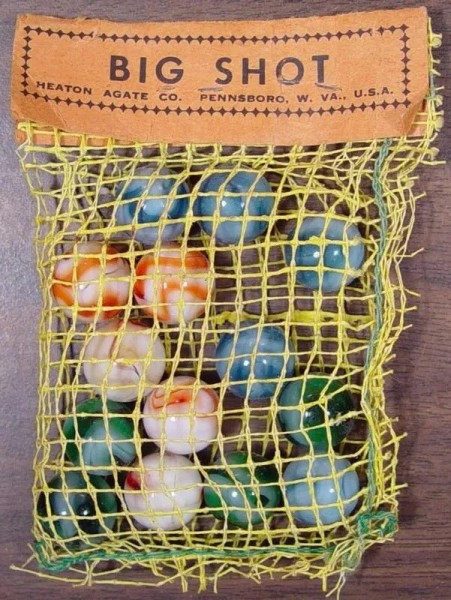
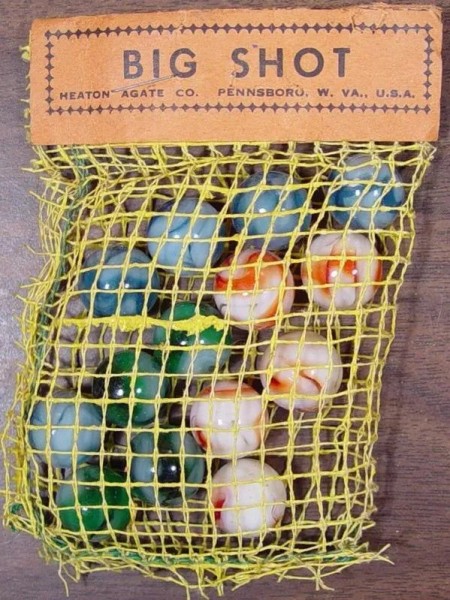
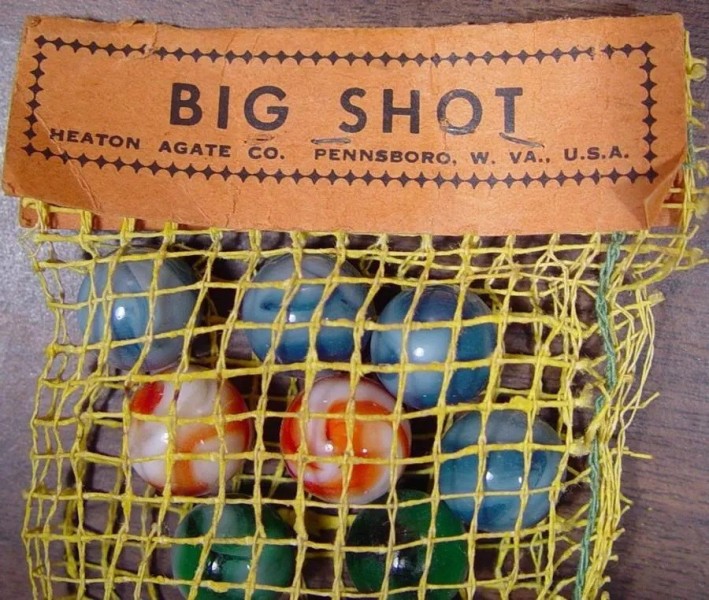
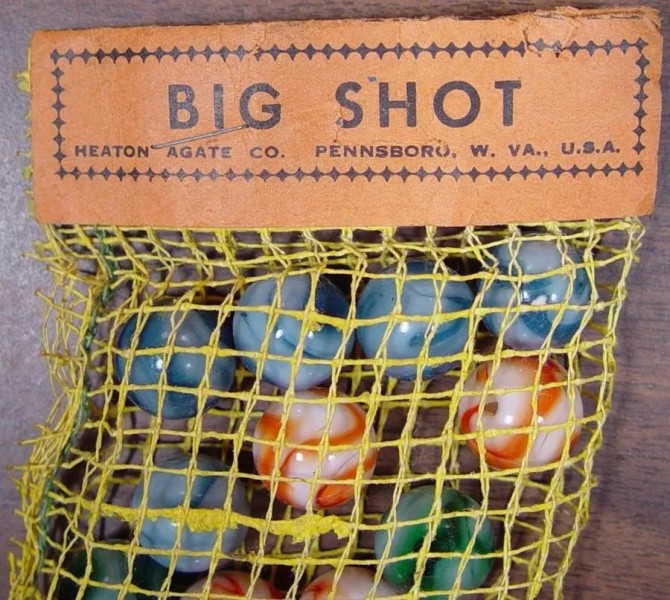
Mostly auction pix. Sources given when known. Click pix to enlarge Big Shot Agate Marbles box: Bull's Eye Marbles bag, from a Poplarhead auction, in which Don identified the marbles as Alleys: From Don's auction listing: Bull's Eye Marbles box, containing 7/16" to 1/2" marbles: Mesh bags. Bull's Eye and Big Shot from Marblealan auctions: Note: There are other pix in the links here, Compilation: Original Packaging. And another bull's eye bag here. Bullseye Mesh Bag W/ Coral Marbles & Mk Mesh Bags
-
Two threads from 2020: Named Heaton types Dug Heaton mib pics Big Shot mesh bags. The first is from a Marblealan auction. Two more: http://i119.photobucket.com/albums/o151/modularforms/Heaton/th_002a.jpg http://i119.photobucket.com/albums/o151/modularforms/Heaton/th_003.jpg Plastic Big Shot bags: http://i119.photobucket.com/albums/o151/modularforms/Heaton/th_IMG_0009.jpg http://i119.photobucket.com/albums/o151/modularforms/Heaton/th_IMG_0008.jpg http://i119.photobucket.com/albums/o151/modularforms/Heaton/th_BigShot010a.jpg Dug marbles, from Rinesmarbles auctions: http://i119.photobucket.com/albums/o151/modularforms/Heaton/Rines001a.jpghttp://i119.photobucket.com/albums/o151/modularforms/Heaton/Rines001b.jpg http://i119.photobucket.com/albums/o151/modularforms/Heaton/Rines002a.jpghttp://i119.photobucket.com/albums/o151/modularforms/Heaton/Rines002b.jpg http://i119.photobucket.com/albums/o151/modularforms/Heaton/Rines03a.jpghttp://i119.photobucket.com/albums/o151/modularforms/Heaton/Rines03b.jpg
-
From the auction description: .
-
Cardinal Red corkscrews, shown in a thread at LOM. Thread is no longer available. (click to enlarge) Post #11 here shows an ad for a box like that, plus a Fire Opal box and 4 Display Cartons (No. 32, No. 64, No. A-16, and No. A-112). Underneath the illustrations of the display cartons is the recipe used for filling them! For example, the No. 64 contains
-
(click links below thumbnails to enlarge) Akro Moonies: (I think from a Rabbit Auction) http://i119.photobucket.com/albums/o151/modularforms/Akro/post-279-1187051523.jpg http://i119.photobucket.com/albums/o151/modularforms/Akro/post-279-1187051532.jpg http://i119.photobucket.com/albums/o151/modularforms/Akro/post-279-1187051538.jpg Akro Flinties: (I think a Morphy Auction) http://i119.photobucket.com/albums/o151/modularforms/Akro/post-279-1204325489.jpg
-
Brian Graham's corkscrew spinner cup has been lost twice. The thread he originally posted it is no more and the copy he let me post is no longer where he hosted it. BUT Dani has a spinner cup and other equipment in this thread: Akro Stats, Cork Counts These patents have been annotated to show where the spinner cup should fit. I didn't do it. I'm still not quite able to picture it myself even with aids like this. (click to enlarge) Check out the color coding to show which glass tank the ribbon is coming from!
-
Here's a thread at the Akron Marbles forum, What exactly is an Akro Agate Imperial, with an Imperials box. The contents are oxbloods. edit: Thread no longer available.
-
Hero box, Brown Thrashers: (click to enlarge) Unique box, Akro style: Unique box, Master style (for comparison): (source: Ron's Marbles, Toys And Things)
-
A definite Popeye patch, and its brother Cork! These two are from the same Popeye box. One of those pictured above. There also seems to be at least one more "error" in that box. (click to enlarge)
-
(click pix to enlarge) Popeye Box with the peewee: #236, the popeye box with the red and blue patch pictured further down in this thread: And now a #116 yellow popeye box: At the time of this writing, this box is being auctioned by Alan. He says the yellow is more rare than the red. His description: (We know that popeye boxes didn't always come with what we now call popeyes.) A note about popeye color combos .... Here's Block's 2002 list in order of increasing rarity: red/yellow green/yellow red/green dark blue/yellow light purple/yellow dark purple/yellow powder blue/yellow red/blue red/orange orange/green blue/green black/yellow hybrids Alan's archived Akro page has practically the same list, but doesn't mention orange/green, and he says "dark blue/red" instead of red/blue. A purple/red has been spotted but didn't make either list.
-
#250 box: (click to enlarge)
-
I think those in this particular bubble gum box would have been sold as Royals. Here's a Royals box Dani posted at LOM, size 11/16" to 23/32". (source) (click link below thumbnail to enlarge) http://i119.photobucket.com/albums/o151/modularforms/Akro/AkroRoyals_Zaboo.jpg
-
Kullerbubbel Gum Box: One day I might decide which views I'm okay with omitting. Until then ... (click links below thumbnails for larger images) http://i119.photobucket.com/albums/o151/modularforms/Akro/bg01.jpg http://i119.photobucket.com/albums/o151/modularforms/Akro/bg02.jpg http://i119.photobucket.com/albums/o151/modularforms/Akro/bg03.jpg http://i119.photobucket.com/albums/o151/modularforms/Akro/bg04.jpg http://i119.photobucket.com/albums/o151/modularforms/Akro/bg05.jpg http://i119.photobucket.com/albums/o151/modularforms/Akro/bg06.jpg http://i119.photobucket.com/albums/o151/modularforms/Akro/bg07.jpg http://i119.photobucket.com/albums/o151/modularforms/Akro/bg08.jpg http://i119.photobucket.com/albums/o151/modularforms/Akro/bg09.jpg
-
(click pix to enlarge) Here's an ad Dani showed in a fire opal discussion. It also has many Akro cartons. Note the descriptions of what each should contain, at least at that time. No. 32 carton: One from Marblealan: Another, possibly from Block: Dani's ad seem to say that there was originally a formula for how to fill these. So far I haven't found one which matches the formula. Though it's possible than these have been backfilled, it is also very easy to believe that the formula turned out to be too inconvenient. This one appears to have more corks than the other 2. So it might come closer to fitting the pattern in Dani's ad but I don't see a cardinal red or any other onyx. That might be an Imperial on the bottom right. No. A-16, I think from Block:
-
Most photos here from auctions. Sources provided where I know them. What kind of "original packaging" is there for Jabo? Here's one bag and its auction description:
-
And now for more. Sources provided where I know them. I wasn't keeping track yet when I saved some of them. (click pix to enlarge) Hy-Grade bag: Dani's: Probably from a Marblealan auction: This one appears to have corks. Possibly Al's. Miscellaneous bags. Mostly patches. Hot Shot bag: Hot Shot. Marbles described as approx. 1 inch. Al's Hot Shot bag, and what he said about it. (3 were missing, a 4th was so great he pulled it out, and he replaced the 4 with corks which looked like they belonged -- the eggyolk oxblood is the one he pulled out)
-
Note: Other pix can be found through the links in the original packaging thread and the general Akro thread. More links: Moss Agate Type Marbles Sweet Akro thread in main chat forum The earliest known Akro box, plus an early Akro ad At this point Akro was selling MFC's under their label. . . . (p.s., note the Akron address) (click pix to enlarge)
-
These bags contain Alleys from the St. Mary's location.
-
A lot of pix. Sources provided when I remember them. (click pix to enlarge) Note: There are many other pix in the links here: Links: Original Packaging Links: Vitro Agate Vitro Timeline And a treasure trove here: Vitro Agate , Marbles And A Little History The sequel ;-): "the" Vitro Thread ! ( Part Deux ;-) Value, Rarity & Names Oh yeah, this has some lovely pix also, from a 1938 ad someone sent me. Vienna Vitros !!! Many of these are from Marblealan auctions: 60 Vitro Agates: 30 Vitro Agates: Vitro's Victory Agates: Vitro Conquerors: Agates, 5 of them, 5/8" to 21/32": Looks like a stock box. No identifying marks. Posted by Nancy at LOM. Boxes like this are shown under the name "Tri-Lite Marbles" in an early Vitro brochure. (source) "More Or Less 100 Vitro Agates". If I understand correctly this box was filled in Vienna. It says Parkersburg because that was Vitro's mailing address even when the factory was in Vienna. (source)
-
Mesh Bag, 25 Champion Agates: (click to enlarge) (source) Note: There are other pix in the links here, Links: Original Packaging. [Actually there aren't any others as of the time of this writing, lol!, but there might be someday.] And here is a great Champion page: David Chamberlain's article at Marble Mental.
-
Some more Pelts. Note: This Marble King label is from before the Marble King company was founded. Sunshine Rippled Wheat premium: Worcester Salt: (click to enlarge) And these playing it safe, with no marble company name, just "Glass Marbles": Morton's Salt: (click to enlarge) And then some more "Glass Marbles", in a Champion Jr. bag, but still not branded Peltier: One more Morton Salt bag. Is it missing marbles, or were some bags packed lighter?
-
This went for $330 at auction in March. The seller described it as a "Fancy Jobber Box". (Who was the seller? Is the blue background Lloyd's trademark?) No. 5, National Onyx marbles: (that last view shows two dividers from inside the box) Chinko-Checko-Marblo box:
-
Way too cool to miss. A printer's block. Here's the auction description: (click to enlarge)
-
Some auction pix from the files. Sorry, wasn't keeping track of the sources yet when I saved most of these first ones. Note 1: the "click to enlarge" option isn't working right since the last forum upgrade. I need to edit this. Note2: There are many other pix in the links here, Compilation: Original Packaging and Links: Peltier 1992 bag: 2002 bag: This bag says, "Elect Cinamon Commisioner". (click to enlarge) What might the ages on these be? Some are Marble King? (click to enlarge) Vintage comics, in reproduction box: (click to enlarge) Another reproduction box: And a couple more reproduction boxes. I think the marbles are Marble King. And I think these would be originals: (click to enlarge)
-
Only Lucky Boys and Girls get Shamrock Marbles. John McCormick marbles. I think these came from Block auctions. Note: There may be other pix in links here, Compilation: Original Packaging.